Wartegg Drawing Completion Test
The Wartegg test is a graphic and projective personality test, which, through a series of strokes, encourages the individual to produce personal drawings. Wartegg based his work on Sander's principle where "individual differences stand out more clearly if the structuring forces of individuals act spontaneously and productively".
The finished drawing is the set of the individual's perception in relation to the stimulus and its representation. The representation expresses the way the individual behaves, how it manifests itself, how it acts, when it is being stimulated in that certain area. Thus, perception expresses sensitivity to the stimulus and representation expresses manifest behavior. Obviously, there is a relationship between the two; between how the individual perceives his situation in relation to the sensitized area and how he behaves.
Wartegg distinguishes three reactions to the test stimuli:
Adaptive
Indifferent
Emphatic
The reaction is ADAPTIVE when the individual comes into contact with the quality of the stimulus.
It is INDIFFERENT when it does not take the stimulus into consideration.
It is EMPHATIC when the person reinforces the quality of the stimulus.
DESCRIPTION OF THE STIMULUS
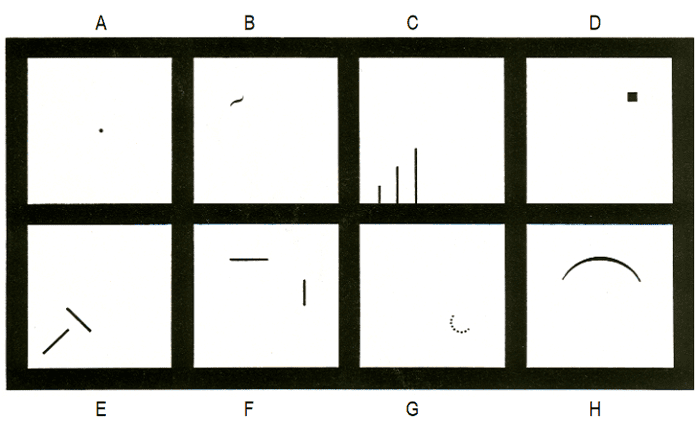
As Wartegg explains in his book "Gestaltung und Charakter", the stimuli elicited in the eight frames are:
Square 1: A small round point located in the center of the box
Something small and irrational, which nevertheless emerges very clearly and that is impossible to ignore since it is located right in the center of the square. It attracts attention and centers on it, fantasy and thought through emotional tension.
It is the field of self-concept (How the individual perceives himself; it indicates growth and expansion).
Square 2: Wavy Line
Finely wavy, it evokes the world of feelings, inspires a fluid, light movement that can be observed in the most abstract elaborations.
It is the field of affection; it indicates the emotional aspects, the capacity to relate and the way in which the affective and the emotional are perceived. This field has two poles, one positive and one negative. (Mother's field).
Square 3: Three Straight, Increasing and Parallel Lines
They constitute a firm and articulated rectilinear group with an impulse for the highest - development defined and directed with order.
It is the field of ambitions, goals, objectives and the life project. It indicates what the individual expects and envisions in the future of and in his life. (Labor projection area).
Square 4: A Solid Black Square placed at the top right of the Box
It gives the impression of weight, of something solid, massive and dark.
It is the field of managing unconscious contents, that is, how testers behave in the face of their anxieties and repressions; it is the field of reaction to pressures.
Square 5: Two perpendicular lines located at the bottom left corner of the box, with a small gap of the cross point
They run in two opposite directions; This is related to conflict, connection, aggression, disagreement and opposition. The remarkable quality of this movement, rich in tension, results from its rigid, strong and virilely active character.
It is the field of management and how it copes with vital energy or its impulses.
Square 6: Two perpendicular lines to each other but do not intersect
They invite, by their position, to the interpretation of a geometric type and are characterized by their sense of disarticulation and reciprocal disagreement.
It is the field that indicates the type of reasoning, the processes of association, analysis and synthesis, that is, it is the field of the cognitive components of the personality.
Square 7: Small Dotted Half Circle
It makes a clear and light impression, imprecise and funny. The qualitative interpretation affects its articulate character, arranged in a subtle way. In addition to the quality of fine decorative articulation, this simple theme suggests a delicately feminine significance.
It is the field of sexual maturity, and at the work level, it indicates the interpersonal attitude at the level of work relationships.
Square 8: Downward-facing Curve
It occupies a large part of the square; it has qualities of concentration and the characteristic of embracing a wide space; it imposes a kind of limits on affective impressions.
It is the field of the workplace itself, implying the ability to commit to the norm, thereby indicating the levels of autonomy. (Father's field).
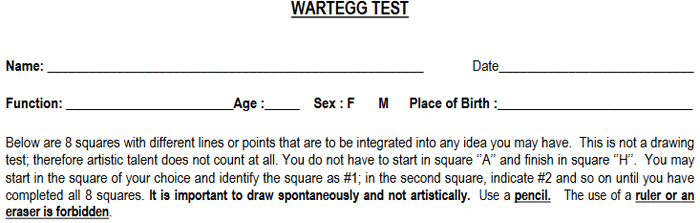
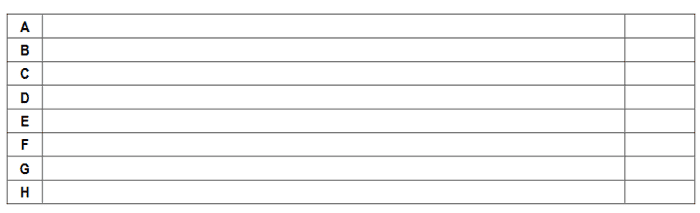
Wartegg Test Form
Basic Analysis and Interpretation of the Wartegg Test
Square 1: A small Round Point
Repainting the stimulus or enlarging it indicates a narcissistic or highly histrionic tendency. It shows a need for self-assertion. Multiplying the stimulus indicates making it disappear or camouflage it among the others, which shows a tendency to insecurity or a low self-concept.
Shading, in general, can be presented in two ways:
1. Smooth or Artistic: It shows an intellectual as well as emotional and natural tendency or
2. Hard and Rough: It shows a tendency to anxiety, distress, or depression.
Square 2: Wavy Line
Drawing faces: It implies a strong tendency to contact others and the importance of emotions. If the drawing of the face has limits, it indicates the tendency to keep the limits in interpersonal relationships, and if it does not have them, it indicates the opposite.
Nature drawing: It indicates the ability to relate, but only in situations of confidence. It also indicates that the person is contemplative.
Drawing an animal: It implies taking into account which animal was drawn, since it shows us what the individual is like in interpersonal relationships and how he considers others.
Drawing objects: It indicates marked avoidance of interpersonal relationships, or a tendency to intellectualization and lack of affective warmth. (Defense mechanism).
Square 3: Three Straight, Increasing and Parallel Lines
Extending the stimulus lines or giving them growth in the form of a building, in an irregular way, can indicate a tendency to be poorly organized.
When the stimulus is canceled, it means that the Tester shows a tendency to feel stuck in his goals in the present.
Drawing stairs that end in a platform, accounts for a completion of the goals achieved, which may indicate that he is satisfied with what he has obtained or he has stalled in hisr purposes.
If the three lines are joined, this may indicate that the individual has few ambitions and only shows them when the environment demands them, without personal initiative.
Square 4: A Solid Black Square
It is recommended that the person draw this square last.
Shading the box may indicate a decrease in the level of activity in the face of conflict or a tendency to depression.
Altering the solid square may indicate an emotional alternation between depressive and excitable states.
Drawing objects with childish content can indicate a childish and immature handling of problems, conflicts or pressure.
Drawing chess or boxes can indicate that he is a strategic person.
Drawing nature presumably indicates that the person is secretly subjective or emotional.
Square 5: Two Perpendicular Lines
Joining the stimuli and directing them to the right diagonally, presumably indicates a tendency to be dynamic and active. The same, but to the left, shows a tendency towards passivity and little dynamism.
If the initial stimuli are not related, but have directionality, it can indicate a tendency to action in which a certain part of that energy is lost.
If the drawing has no direction, this may indicate a damming of psychic energy (Too much repression).
Drawing objects can indicate the inadequate channeling of energy.
Square 6: Two perpendicular lines to each other but do not intersect
The integration of the lines can indicate an adequate and balanced trend between associations and synthesis in ideas.
Drawing two different but associated drawings may indicate a style of reasoning with better processes of association than synthesis.
Drawing unrelated elements, presumably indicates problems in the association, analysis, and synthesis processes.
Disregarding lines when drawing may indicate a low confidence of the individual in his abilities.
Square 7: Small Dotted Half Circle
Respecting the initial drawing can show a tendency to maintain quality in relationships.
If the drawing has a real function, it can indicate a tendency to a good sexual, affective and interpersonal maturity.
When the initial figure is studded or something childish is drawn, this can indicate sexual, affective and interpersonal immaturity.
Square 8: Downward-facing Arc
If the drawing is below the initial arc, this may indicate a high level of filiation, and a level of non-introjective submission to the norms.
If the drawing is above the arc, it indicates a high level of criticism and difficulty with the rules and laws.