Mechanical Reasoning: Communicating Vessels or Principle of Siphon
Communicating vessels are the containers communicated from one side and containing any liquid. When the liquid is at rest, it reaches the same level in all containers, no matter the shape or volume of the containers. If more liquid is added to any of the containers, it is distributed until it reaches a new level, anyway, the same in all the receivers, it does not matter if we decide to vary the position of the containers.
Exercise 5
What is the maximum level that the water will reach in the container on the right, once the faucet is turned on?
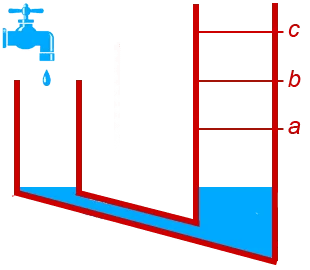
The water will rise up to
1. "a"
2. "b"
3. "c"
SOLUTION:
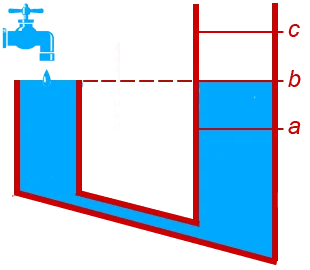
The total water level cannot exceed level "b", since this will have to be THE SAME in both containers. Once the water level reaches the edge of the first reservoir, it cannot rise any further at the other end.
Blaise Pascal was a renowned French mathematician, physicist, and philosopher who made significant contributions to the development of fluid statics. The principle of interconnected vessels is based on a fundamental principle of fluid statics: when the same liquid is poured into several interconnected vessels and left at rest, regardless of the shape or size of the vessels, the liquid level in each will remain at the same height.
Galileo Galilei's research on fluid mechanics and motion also laid an important foundation for later fluid statics. His scientific investigation inspired Pascal and other subsequent scientists to further develop the theory of fluid pressure and equilibrium.